Problem Overview
The Sumo Robot is a competition where
two robots compete against each other.
They are confined in a ring of a specified size from which they will be
competing in. The goal is simple: The robot needs to push the opposing robot
out of the ring and avoid falling out itself. An entire match consists of three
rounds that can last up to a maximum of three minutes. The first robot to push
the opposing out of the ring during a round will receive one point. If a robot
moves outside the ring on its own, the opposing robot also receives one point. The
team whose robot scores two points first is declared the winner of the match.
Design Constraints
The competition allows design of
various dimensions and weight depending on the class the robots will be under.
By using a Lego NXT kit to construct a sumo robot, certain requirements must be
made in order for the robot to be able to compete. The ring the robots will be
competing in will have a diameter of 77 centimeters and a height of 2.5
centimeters. The robots themselves have a weight limit of 1,000 grams, or about
2.2 pounds. The size of the robot is restricted to a 15 cm x 15 cm area. The
height, however, has no restrictions and can be made into any length desired.
The Lego class sumo robots are
only allowed to be autonomous. This means that the robot must be fully capable
of competing in a match on its own without the aid of human remote control or
networking. The design of the robot is restricted from using certain tools that
have the potential to damage the ring or the opposing robot. Such restrictions
include, but are not limited to: jamming devices, flammable materials, or sharp
edges capable of damaging the ring. For this specific case, the robot must be
constructed using only Lego pieces.
Pre-Existing Solutions
Many of the previous competitors of
the Robot Sumo competition have utilized a defensive design in order to protect
the robot from certain obstacles. One of these defensive designs includes the
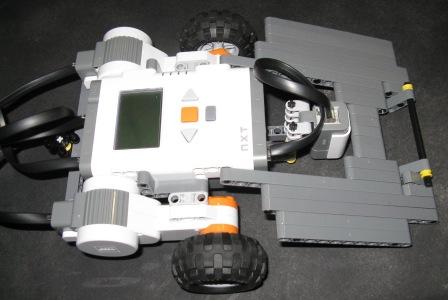
addition of a ramp. As seen in Figure 1, the robot has an inclined plane used
as a ramp placed in front of the robot’s main body. It extends from the top of
the robot to the floor in order to prevent any obstruction to slide underneath
the robot and potentially disrupt its maneuvering capabilities. Also, while
protecting the robot from being scooped up, it could also scoop under the
opposing robot and cause it to flip over and become disabled.
Figure 1: A Lego NXT Robot with a ramp installed in front of the
main body.
An
even greater defensive design is the protection of the robot’s locomotion. Some
designers have gone as far as to use pieces to make a guard for their wheels as
shown in Figure 2 below. In the picture you can see the structure built around
the wheels to protect them being dislodged and also to prevent the gears from
being disrupted. Without these the wheels could become loose, and eventually
the robot would become immobilized.
Figure 2: Lego NXT Robot. A cage-like shell is encased around the
wheels of the robot to protect it from potential damage.
Pertaining
to how the robot will sense the environment around it, one idea most designers
include is the use of a color sensor to detect where it is in the ring based on
the change of color as seen in Figure 3. The ring will be colored black and the
outer line that extends to the edge of the ring will be colored white. When the
color sensor senses this change, it should know that it is about to be taken
outside of the ring and should perform evasive maneuvers to avoid falling out.
Figure 3: A robot design with the color sensor
positioned downward. It is used by sensing the change in color of the arena.
That is when it should know that it is about to fall out of the ring.
To sense where the opponent is
located, the general idea is to utilize an ultrasonic sensor. By sending out a
sound wave signal and detecting the time it takes for the signal to return, it
can determine how far an object is. As seen in Figure 4, the ultrasonic is
positioned at the front of the robot. The idea is to use the sensor to detect
the opposing robot. When it does detect, the robot will perform the maneuvers
necessary to push the robot out of the ring.
Figure 4: A robot design with an ultrasonic
sensor. It is used to detect the opposing robot in order to find out where it needs to move.
Design Goal
The
main goal of the project at hand is to design a robot that will portray
sumo-like characteristics. In order to achieve the main goal, two main
attributes have to be discussed: The offensive attributes of the robot and the
defensive attributes.
In
regards to the defensive attributes, the robot will be constructed with a low
gear ratio, which will provide more torque, which would provide more power
rather than more speed. This trait will pose a great effect while the robot is
under attack. If the other robot is pushing on our group’s robot the torque
will provide a robust grip and power, hence defending itself against an enemy
push. The sumo-robot will also have 8 wheels, which will help keep traction
while an enemy is pushing. The color sensor will be extremely important in the
defensive aspect of the competition. There will be a white line tracing a
circle of 77 cm where the inside of the circle will be a dark color. Two color
sensors will be place at each end of the sumo-robot facing downwards in order
to detect the change of color and back up in order to stay in the circle. There
is a specific difference with pre-existing designs; our robot will have two
color sensors instead of a classic one-color sensor robot. This is mainly
because an enemy robot could be pushing the side of the robot that does not
have the sensor and when the robot reaches the line it will be too late for the
sensor to react because more than half of the robot would be already over the
line. Therefore 2 sensors at back and front of the robot will avoid that
problem.
In
regards to the offensive attributes of the robot, there will be two ultrasonic
sensors placed at the top of the robot in order for the robot to detect an
enemy and attack it. The reason behind two ultrasonic sensors instead of the
common one sensor is simple. With two sensors our robot would detect the enemy
robot faster and attack faster anticipating an enemy attack. Another
fundamental offensive characteristic that the robot will have in order to
successfully push the robot out of the ring is a motor-operated lifter. It will
be placed at the front of the robot and the target of this offensive trait is
to lift the opposing robot so the wheels of the robot will be useless and
therefore leave the enemy robot completely defenseless. A third motor will
operate this lifter. On the back of the robot there will be a slanted surface
which will lessen the force of an enemy attack because it is much harder to
push on an angle. These offensive attributes differ from pre-existing models
because a pre-existing model will have only one attack mechanism, and normally
a motor does not power it. In this particular case, the robot has two attack
mechanisms, which prevents an attack from the back. Therefore the robot can
defend itself from the front and the back.
Project Deliverables
This
group will be handing in a working NXT robot that will compete against other
robots in the final competition. At the end of the term, this robot will be
completed to what is shown in the Project Schedule below. However, some minor
modifications may be done over the course of the term.
Project Schedule
Week 3
|
To
have a strong chassis, working gear system for the wheels, and ideas about
where to place certain sensors
|
Week 4
|
To
stabilize the gears, provide protection for the wheels by constructing a low
clearance wall, and developing a design for a ramp to place at the front of
the robot
|
Week 5
|
Finish
the set physical design for the robot and smooth out any flaws
|
Week 6
|
Start
developing the code for each specific sensors and start to develop a search
pattern to find the other robot
|
Week 7
|
Modify
the search pattern and start to integrate each piece of coding from each
sensor
|
Week 8
|
Modify
the code to make sure that it works as designed and fine tune any bugs in the
program
|
Week 9
|
Test
the robot against another robot and see what needs to be fixed or changed
|
Week 10
|
Make
sure the robot works as intended and begin the competition
|
Projected
Budget
There is no projected budget for the project.
When or if extra parts are required, they can be provided via the Engineering
Labs in Bossone. However, if the parts required for our design are not
available for the Labs to provide, the group will directly pay for the parts.
References